Sapele
Entandrophragma cylindricum · Hardwood · West Africa
Properties
| Janka hardness | 1,510 lbf (6,716 N) |
|---|---|
| Average dried weight (est.) | 34 lb/ft³ (550 kg/m³) |
| Specific gravity | 0.55 |
| Modulus of rupture | 15,300 psi (105.5 MPa) |
| Modulus of elasticity | 1.82 million psi (12.55 GPa) |
| Crushing strength | 8,160 psi (56.3 MPa) |
| Shrinkage — radial | 4.6% |
| Shrinkage — tangential | 7.4% |
| Shrinkage — volumetric | 14.0% |
| Shrinkage T/R ratio | 1.6 |
Values at 12% moisture content, clear-wood averages. Source: USDA Forest Products Laboratory, Wood Handbook FPL-GTR-282 (2021), Table 5-5b p. 5-24; shrinkage Table 4-4 p. 4-9.
Sapele is a large West and Central African mahogany-family hardwood (specific gravity 0.55, Janka hardness 1,510 lbf) whose mechanical properties are, in general, higher than those of white oak. It is listed as Vulnerable on the IUCN Red List and is not listed in the CITES Appendices.
Appearance & grain
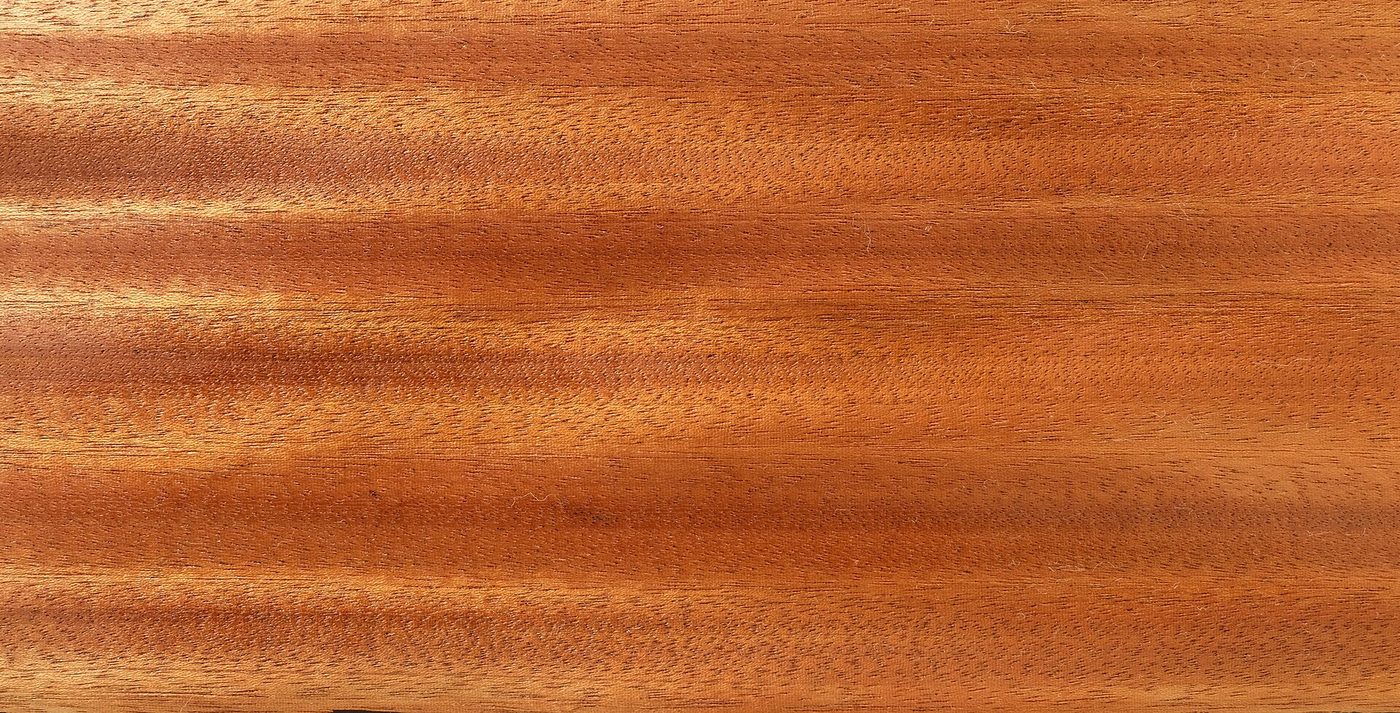
The heartwood ranges in color from that of American mahogany to a dark reddish or purplish brown, and the lighter, distinct sapwood may be up to 10 cm (4 in.) wide. The texture is rather fine, and the interlocked grain produces the narrow, uniform ribbon striping seen on quartersawn surfaces.
Durability
The Handbook rates sapele heartwood as moderately durable, and resistant to preservative treatment.
Workability
The Handbook says sapele works fairly easily with machine tools, although the interlocked grain makes it difficult to plane. It finishes and glues well.
Common uses
- Furniture
- Cabinetwork
- Joinery
- Flooring
- Decorative plywood veneer
Conservation: IUCN Red List: Vulnerable (checked 2026-10-25).
Work with Sapele
Similar woods
Photo: Philipp Zinger · CC BY-SA 4.0 (source)
Property data: USDA Forest Products Laboratory, Wood Handbook — Wood as an Engineering Material, FPL-GTR-282 (2021).