Hackberry
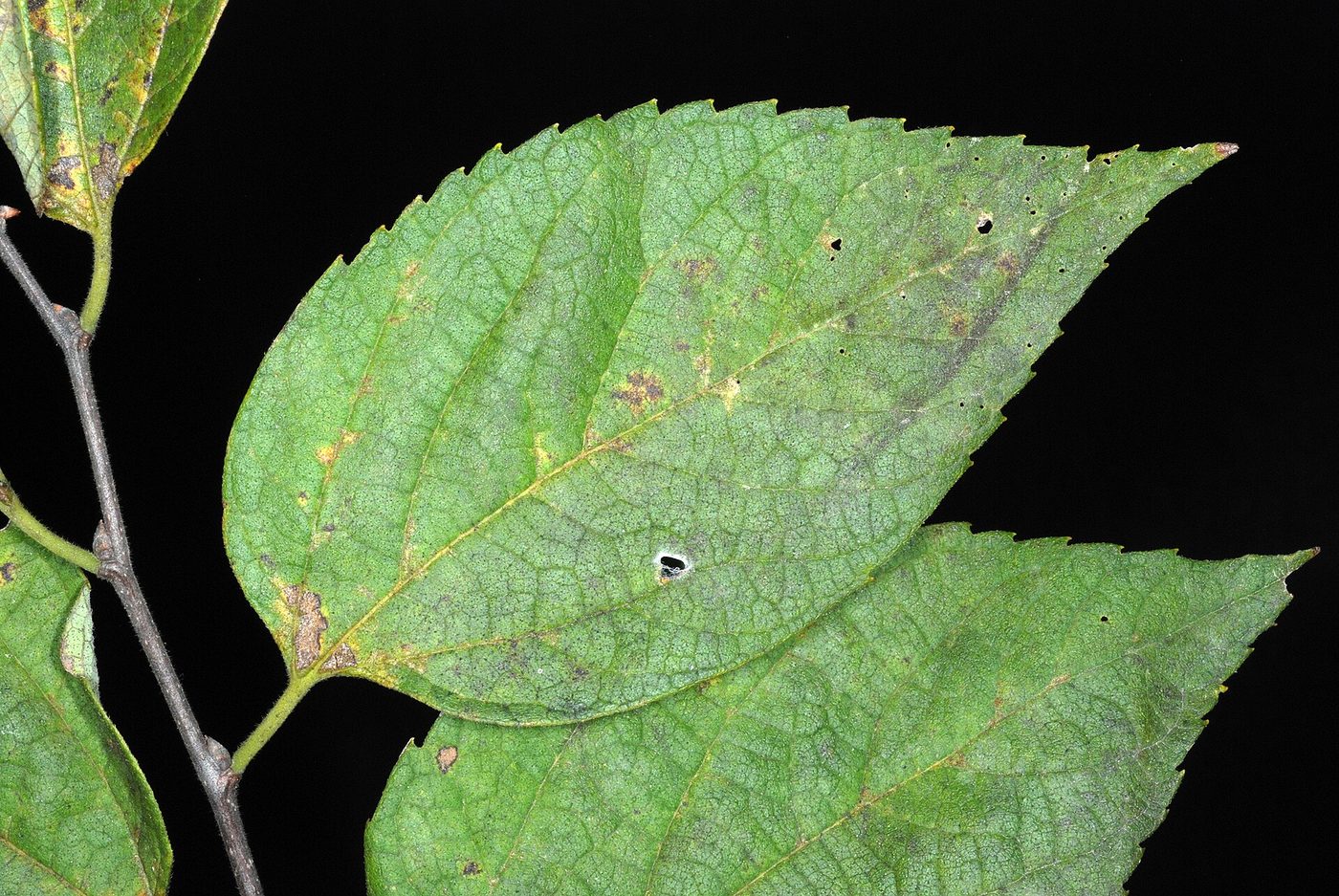
Celtis occidentalis · Hardwood · North America
Properties
| Janka hardness | 880 lbf (3,914 N) |
|---|---|
| Average dried weight (est.) | 33 lb/ft³ (530 kg/m³) |
| Specific gravity | 0.53 |
| Modulus of rupture | 11,000 psi (75.8 MPa) |
| Modulus of elasticity | 1.19 million psi (8.21 GPa) |
| Crushing strength | 5,440 psi (37.5 MPa) |
| Shrinkage — radial | 4.8% |
| Shrinkage — tangential | 8.9% |
| Shrinkage — volumetric | 13.8% |
| Shrinkage T/R ratio | 1.9 |
Values at 12% moisture content, clear-wood averages. Source: USDA Forest Products Laboratory, Wood Handbook FPL-GTR-282 (2021), Table 5–3b p. 5–9; shrinkage Table 4–3 p. 4–8.
Hackberry grows east of the Great Plains, and its lumber, sold together with sugarberry, resembles elm in structure. It is moderately heavy with high shock resistance and goes mainly into furniture parts and dimension stock.
Appearance & grain
The sapwood is pale yellow to greenish or grayish yellow, and the heartwood is commonly somewhat darker. In structure, the wood resembles elm.
Workability
Hackberry is moderately strong in bending but moderately weak in compression parallel to the grain, moderately hard to very hard, and low in stiffness. It has high shrinkage but keeps its shape well in drying.
Common uses
- Furniture parts
- Dimension stock
- Veneer
- Lumber
Conservation: IUCN Red List: Least Concern (checked 2026-10-24).
Work with Hackberry
Similar woods
Photo: DouglasGoldman · CC BY-SA 4.0 (source)
Property data: USDA Forest Products Laboratory, Wood Handbook — Wood as an Engineering Material, FPL-GTR-282 (2021).