Honey Locust
Gleditsia triacanthos · Hardwood · North America
Properties
| Janka hardness | 1,580 lbf (7,028 N) |
|---|---|
| Modulus of rupture | 14,700 psi (101.4 MPa) |
| Modulus of elasticity | 1.63 million psi (11.24 GPa) |
| Crushing strength | 7,500 psi (51.7 MPa) |
| Shrinkage — radial | 4.2% |
| Shrinkage — tangential | 6.6% |
| Shrinkage — volumetric | 10.8% |
| Shrinkage T/R ratio | 1.6 |
Values at 12% moisture content, clear-wood averages. Source: USDA Forest Products Laboratory, Wood Handbook FPL-GTR-282 (2021), Table 5–3b p. 5–10; shrinkage Table 4–3 p. 4–8.
Honey locust is a very hard, strong hardwood (Janka hardness 1,580 lbf, bending strength 14,700 psi) with an attractive figure and color, but the Handbook notes it is little used because the tree is scarce. What is cut goes mostly to local fence posts, general construction, pallets, and crating.
Appearance & grain
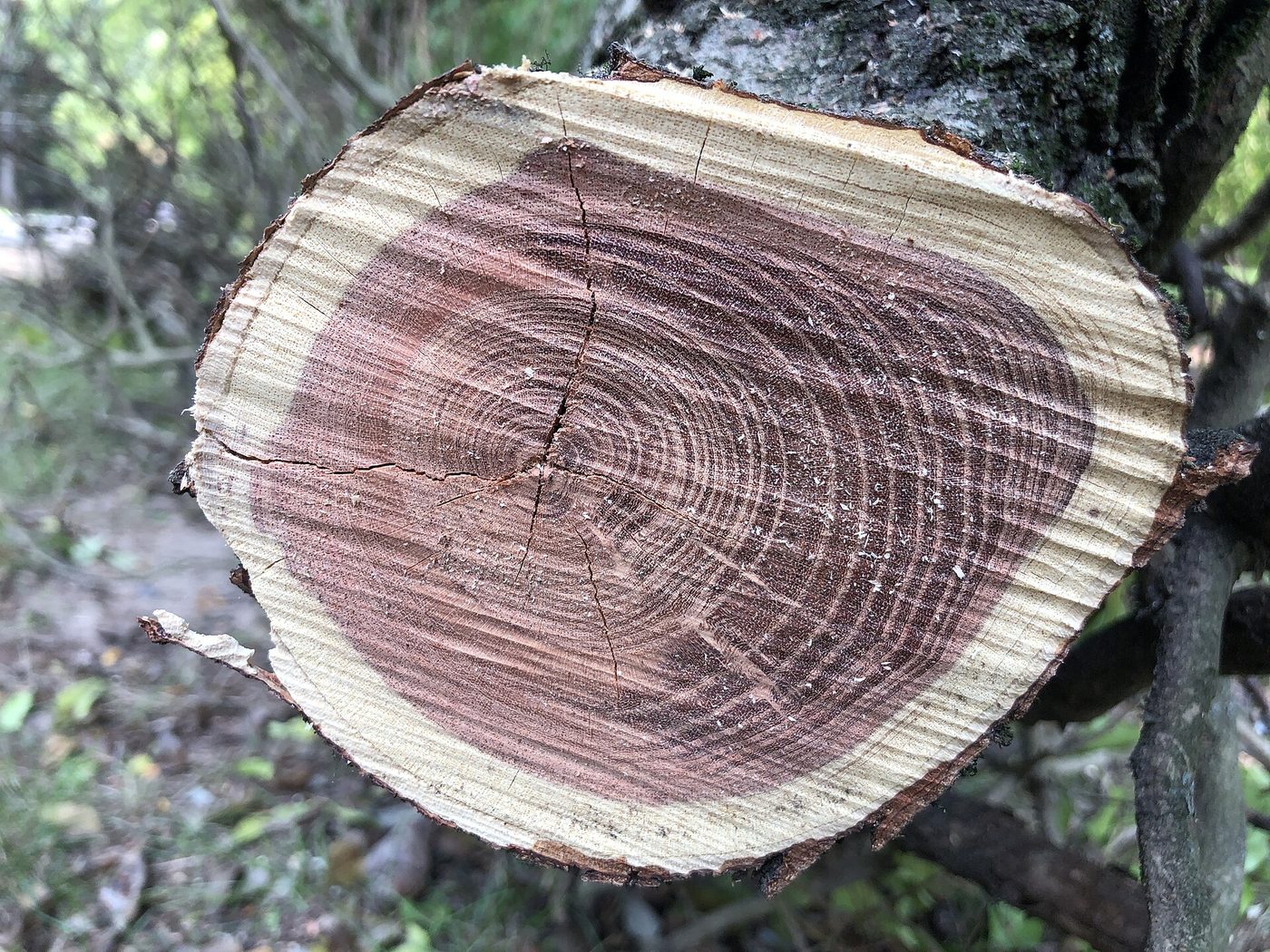
The sapwood is wide and generally yellowish. The heartwood is light red to reddish brown, and the wood's figure and color are attractive.
Workability
The Handbook emphasizes honey locust's hardness and strength rather than any ease of working. Scarcity of the tree, not the wood's properties, is what keeps it out of wider commercial use.
Common uses
- Fence posts
- General construction
- Pallets
- Crating
Conservation: IUCN Red List: Least Concern (checked 2026-10-24).
Work with Honey Locust
Similar woods
Photo: Famartin · CC BY-SA 4.0 (source)
Property data: USDA Forest Products Laboratory, Wood Handbook — Wood as an Engineering Material, FPL-GTR-282 (2021).