Incense Cedar
Calocedrus decurrens (Torrey) Florin · Softwood · North America
Properties
| Janka hardness | 470 lbf (2,091 N) |
|---|---|
| Average dried weight (est.) | 23 lb/ft³ (370 kg/m³) |
| Specific gravity | 0.37 |
| Modulus of rupture | 8,000 psi (55.2 MPa) |
| Modulus of elasticity | 1.04 million psi (7.17 GPa) |
| Crushing strength | 5,200 psi (35.9 MPa) |
| Shrinkage — radial | 3.3% |
| Shrinkage — tangential | 5.2% |
| Shrinkage — volumetric | 7.7% |
| Shrinkage T/R ratio | 1.6 |
Values at 12% moisture content, clear-wood averages. Source: USDA Forest Products Laboratory, Wood Handbook FPL-GTR-282 (2021), Table 5–3b p. 5–11; shrinkage Table 4–3 p. 4–8.
Incense-cedar is a light, soft western softwood (specific gravity 0.37, Janka hardness 470 lbf) best known as the classic pencil wood. Its decay-resistant heartwood also puts it into fence posts, blinds, and outdoor uses where stronger woods are not required.
Appearance & grain
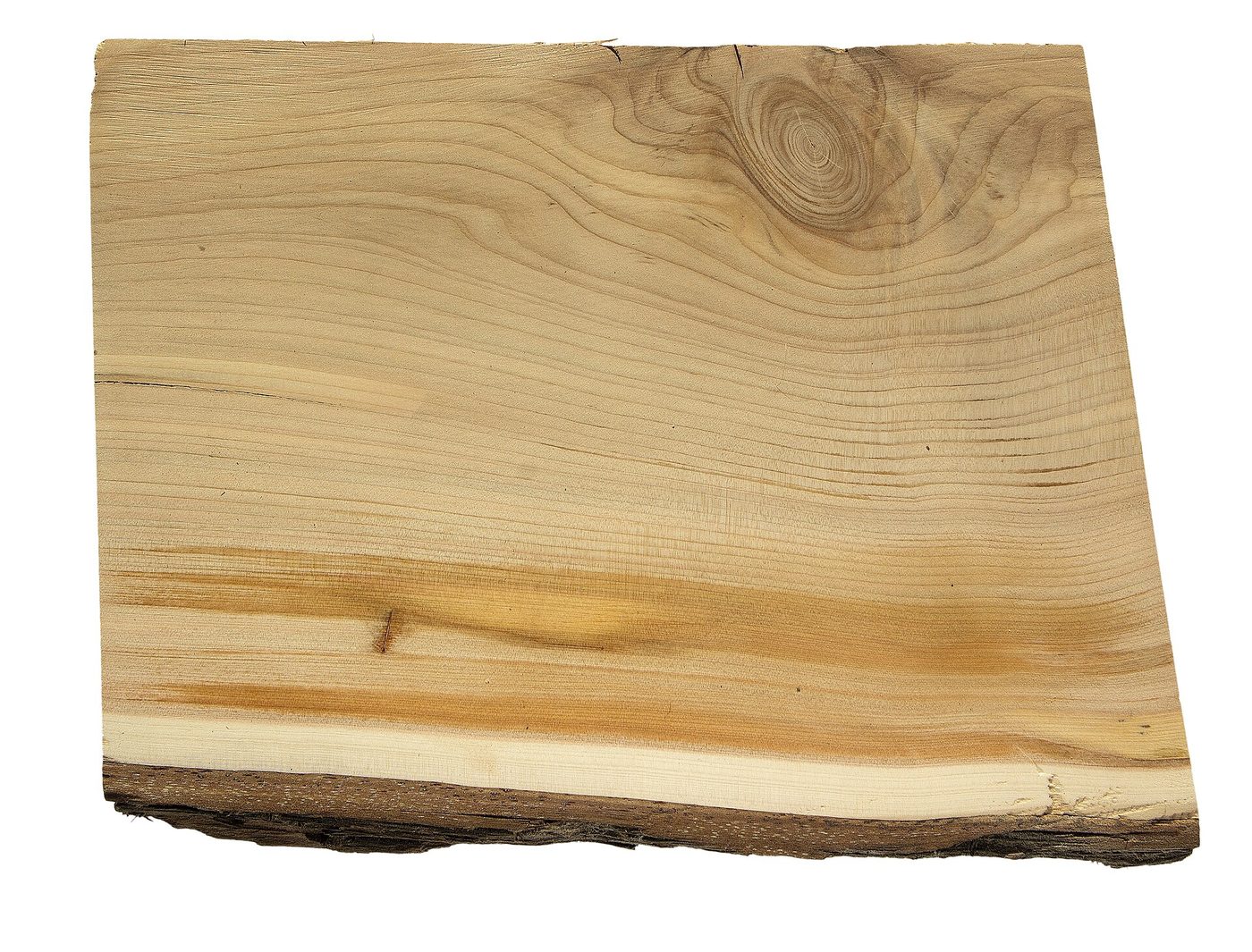
The sapwood is white to cream colored. The heartwood is light brown, often tinged with red. The texture is fine and uniform, and the wood carries a spicy odor.
Durability
The Handbook treats incense-cedar heartwood as resistant to decay — the property behind its long use for fence posts and for the 'pecky' lumber sold for paneling and other spots where decay resistance matters.
Workability
The wood is light and soft with low strength and stiffness, so it cuts without much resistance. Shrinkage is low, and the Handbook notes that it dries easily with little checking or warping.
Common uses
- Pencils
- Venetian blinds
- Fence posts
- Chests
- Toys
- Railroad crossties
- Poles
- Split shingles
- Composite fireplace logs
- Lumber
Conservation: IUCN Red List: Least Concern (checked 2026-10-24).
Work with Incense Cedar
Similar woods
Photo: Roger Culos · CC BY-SA 4.0 (source)
Property data: USDA Forest Products Laboratory, Wood Handbook — Wood as an Engineering Material, FPL-GTR-282 (2021).