Redwood
Sequoia sempervirens (D. Don) Endl. · Softwood · North America
Properties
| Janka hardness | 480 lbf (2,135 N) |
|---|---|
| Average dried weight (est.) | 25 lb/ft³ (400 kg/m³) |
| Specific gravity | 0.40 |
| Modulus of rupture | 10,000 psi (69.0 MPa) |
| Modulus of elasticity | 1.34 million psi (9.24 GPa) |
| Crushing strength | 6,150 psi (42.4 MPa) |
| Shrinkage — radial | 2.6% |
| Shrinkage — tangential | 4.4% |
| Shrinkage — volumetric | 6.8% |
| Shrinkage T/R ratio | 1.7 |
Values at 12% moisture content, clear-wood averages. Source: USDA Forest Products Laboratory, Wood Handbook FPL-GTR-282 (2021), Table 5-3 p. 5-13; shrinkage Table 4-3 p. 4-8.
Redwood is a moderately lightweight softwood (specific gravity 0.40, Janka hardness 480 lbf) whose old-growth heartwood is highly resistant to decay, the property behind its use in decking, tanks, silos, and cooling towers. Most redwood lumber goes into building, siding, and millwork.
Appearance & grain
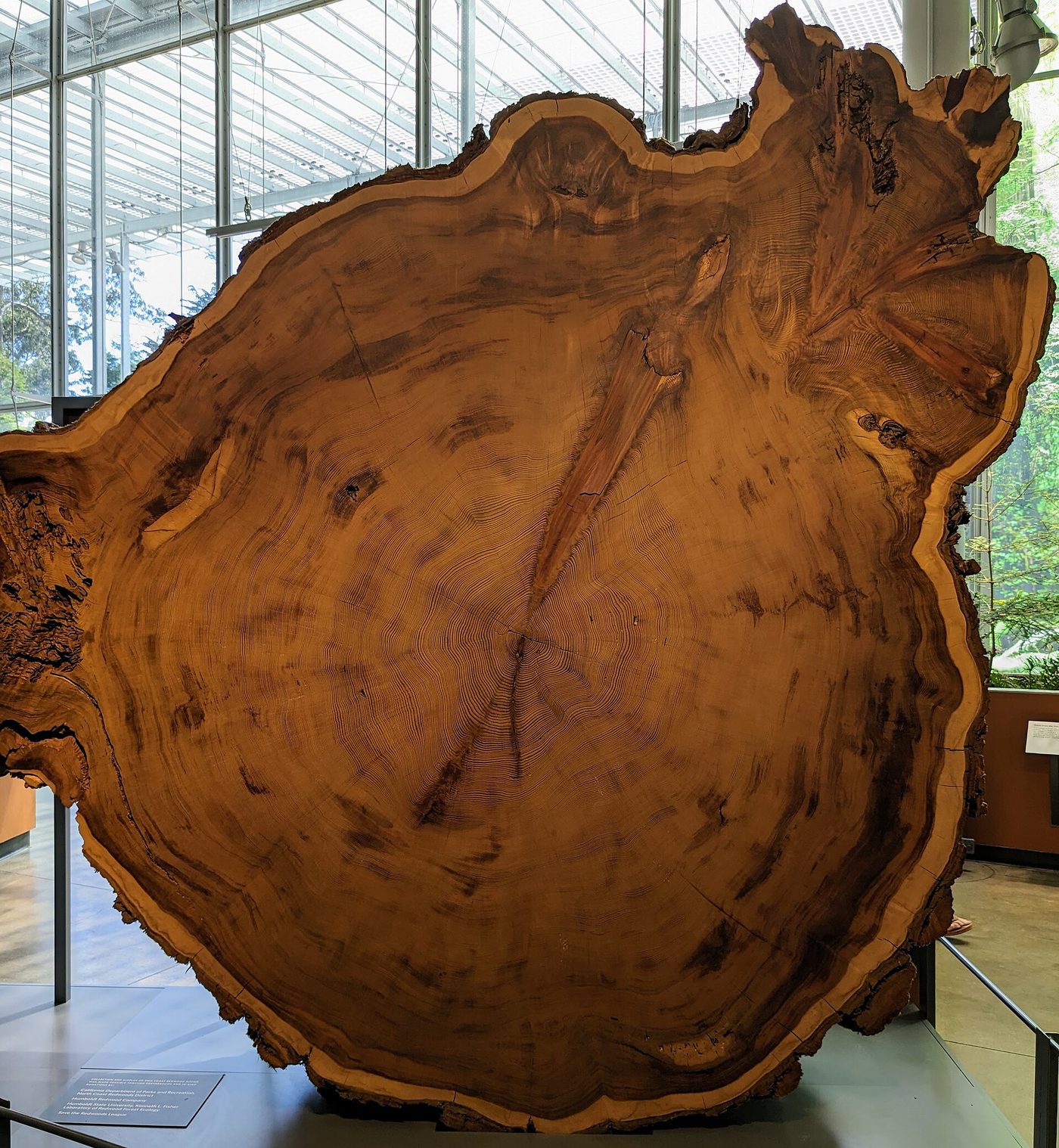
The heartwood ranges from a light cherry red to a dark mahogany. The sapwood is narrow and almost white. Typical old-growth wood is generally straight grained.
Durability
Old-growth heartwood is highly resistant to decay; second-growth heartwood rates only low to moderate.
Workability
Old-growth redwood is moderately strong and stiff and moderately hard, and it is easy to work. It shrinks and swells comparatively little: its volumetric shrinkage of 6.8% is the lowest in this set.
Common uses
- Siding
- Sashes
- Doors
- Blinds
- Millwork
- Casket stock
- Containers
- Cooling towers
- Decking
- Tanks
- Silos
- Wood-stave pipe
- Outdoor furniture
- Posts and fence material
- Decorative veneer plywood
Conservation: IUCN Red List: Endangered (checked 2026-10-24).
Work with Redwood
Similar woods
Photo: Elwood P. Dowd · CC BY-SA 4.0 (source)
Property data: USDA Forest Products Laboratory, Wood Handbook — Wood as an Engineering Material, FPL-GTR-282 (2021).