Ipe
Tabebuia spp. · Hardwood · South America
Properties
| Janka hardness | 3,680 lbf (16,369 N) |
|---|---|
| Average dried weight (est.) | 57 lb/ft³ (920 kg/m³) |
| Specific gravity | 0.92 |
| Modulus of rupture | 25,400 psi (175.1 MPa) |
| Modulus of elasticity | 3.14 million psi (21.65 GPa) |
| Crushing strength | 13,010 psi (89.7 MPa) |
| Shrinkage — radial | 6.6% |
| Shrinkage — tangential | 8.0% |
| Shrinkage — volumetric | 13.2% |
| Shrinkage T/R ratio | 1.2 |
Values at 12% moisture content, clear-wood averages. Source: USDA Forest Products Laboratory, Wood Handbook FPL-GTR-282 (2021), Table 5-5b p. 5-23; shrinkage Table 4-4 p. 4-9.
Ipe is the extremely dense, durable lapacho-group hardwood of Latin America (specific gravity 0.92, Janka hardness 3,680 lbf) — so heavy that thoroughly air-dried heartwood generally sinks in water. The genera behind ipe (Handroanthus, Tabebuia, and Roseodendron) entered CITES Appendix II effective November 25, 2024, and the principal traded species, Handroanthus serratifolius, is listed as Endangered on the IUCN Red List.
Appearance & grain
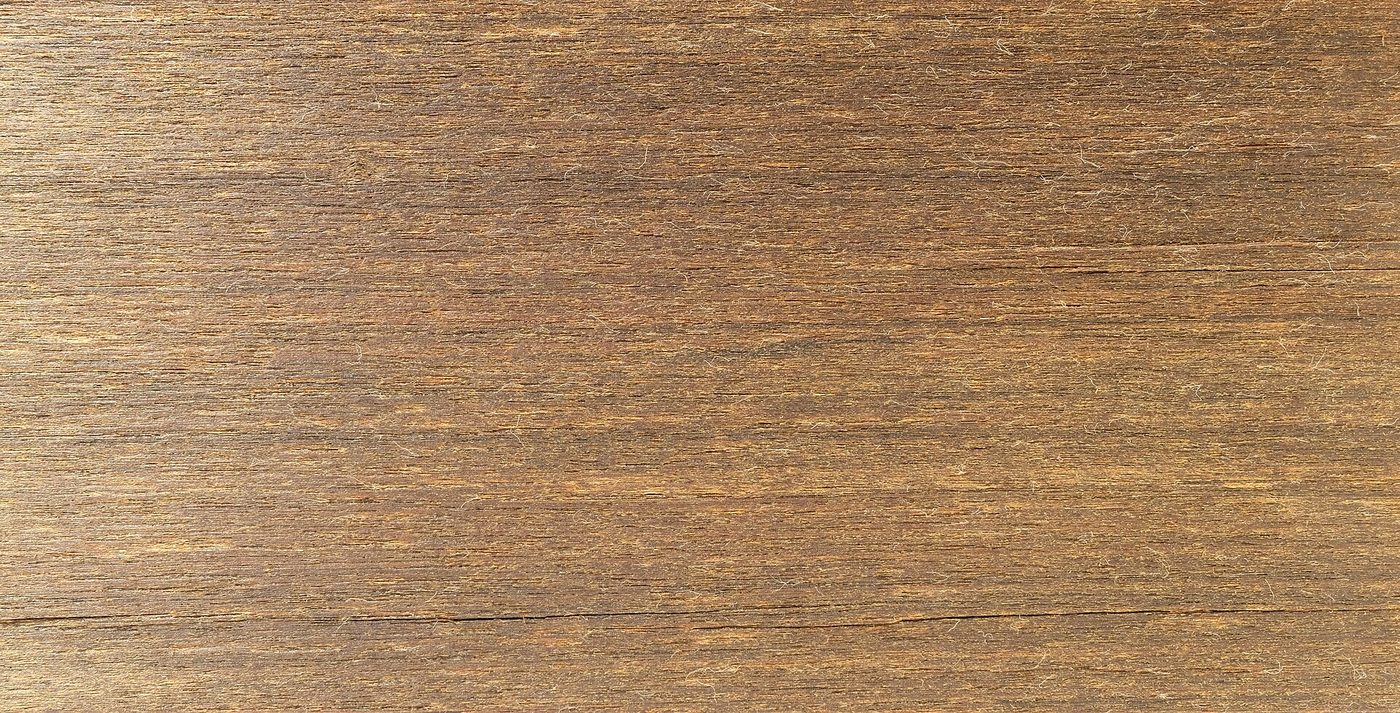
The sapwood is relatively wide, yellowish gray or gray-brown, and sharply differentiated from the heartwood, which runs from light to dark olive brown. The texture is fine to medium, and the grain is straight to very irregular and often narrowly interlocked.
Durability
The Handbook rates ipe as highly resistant to decay and to insects, including both subterranean and dry-wood termites — though it is susceptible to marine borer attack — and the heartwood is impermeable to preservative treatment.
Workability
The Handbook notes that ipe's high density and hardness — two to three times that of white oak — make it moderately difficult to machine, though glassy smooth surfaces can be produced. In the air-dried condition its strength is comparable with greenheart.
Common uses
- Heavy construction
- Heavy-duty flooring
- Decking
- Railroad crossties
- Turnery
- Tool handles
- Decorative veneer
Conservation: listed in CITES Appendix II · IUCN Red List: Endangered (checked 2026-10-25).
Work with Ipe
Similar woods
Photo: Philipp Zinger · CC BY-SA 4.0 (source)
Property data: USDA Forest Products Laboratory, Wood Handbook — Wood as an Engineering Material, FPL-GTR-282 (2021).