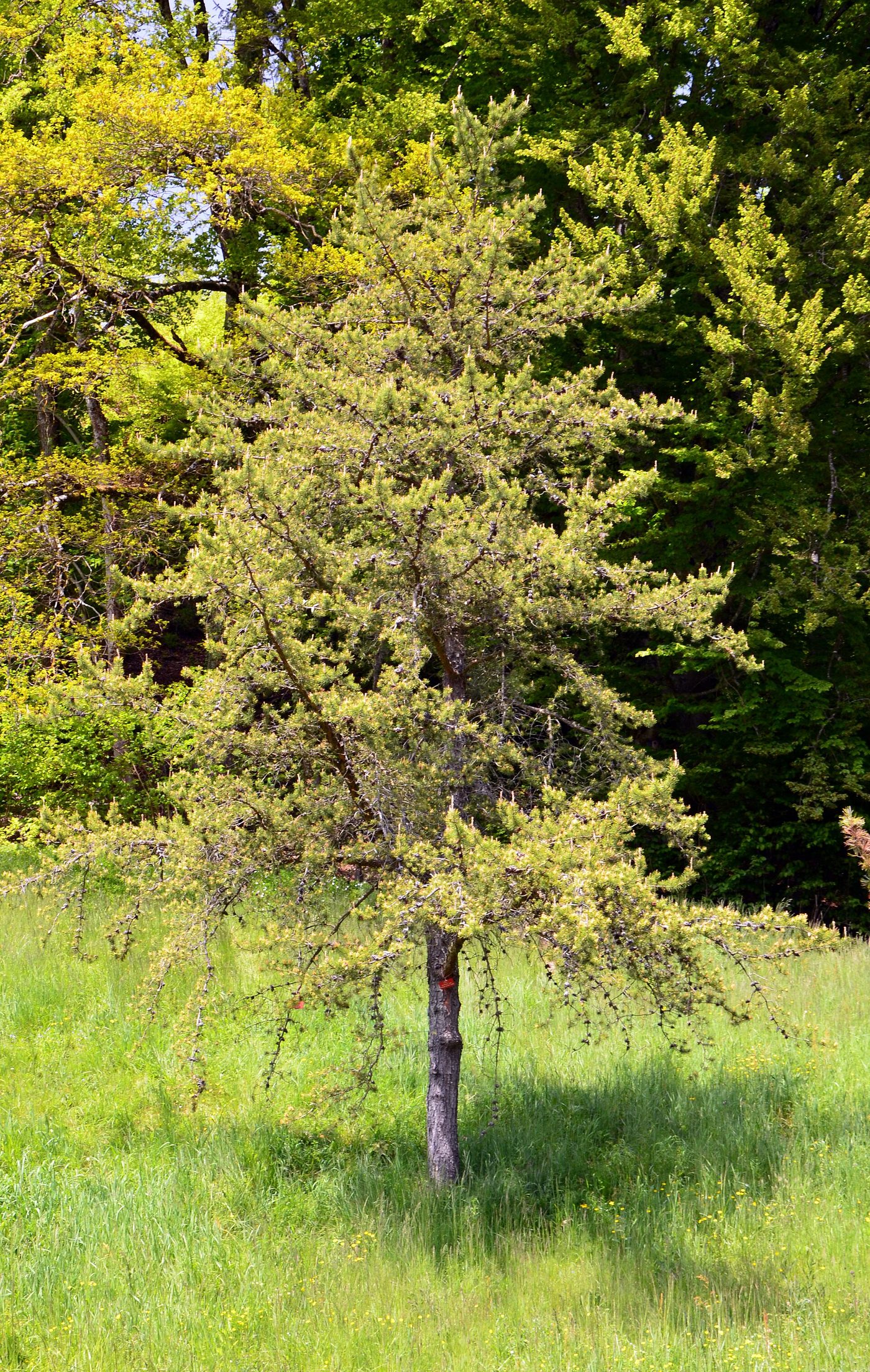
Jack pine
Pinus banksiana Lamb. · Softwood · North America
Properties
| Janka hardness | 570 lbf (2,535 N) |
|---|---|
| Average dried weight (est.) | 27 lb/ft³ (430 kg/m³) |
| Specific gravity | 0.43 |
| Modulus of rupture | 9,900 psi (68.3 MPa) |
| Modulus of elasticity | 1.35 million psi (9.31 GPa) |
| Crushing strength | 5,660 psi (39.0 MPa) |
| Shrinkage — radial | 3.7% |
| Shrinkage — tangential | 6.6% |
| Shrinkage — volumetric | 10.3% |
| Shrinkage T/R ratio | 1.8 |
Values at 12% moisture content, clear-wood averages. Source: USDA Forest Products Laboratory, Wood Handbook FPL-GTR-282 (2021), Table 5-3 p. 5-12; shrinkage Table 4-3 p. 4-8.
Jack pine is a moderately lightweight northern pine (specific gravity 0.43, Janka hardness 570 lbf) of modest strength, used mainly for pulpwood, box lumber, and pallets. Its lumber is generally knotty.
Appearance & grain
The sapwood is nearly white and can make up half or more of the tree's volume. The heartwood is light brown to orange. The texture is rather coarse and the wood somewhat resinous.
Workability
The Handbook rates jack pine moderately low in bending and compressive strength and in shock resistance, and low in stiffness. Its shrinkage is moderately low.
Common uses
- Pulpwood
- Box lumber
- Pallets
- Railroad crossties
- Mine timber
- Slack cooperage
- Poles
- Posts
- Fuel
Conservation: IUCN Red List: Least Concern (checked 2026-10-24).
Work with Jack pine
Similar woods
Photo: Gzzz · CC BY-SA 4.0 (source)
Property data: USDA Forest Products Laboratory, Wood Handbook — Wood as an Engineering Material, FPL-GTR-282 (2021).