Red pine
Pinus resinosa Ait. · Softwood · North America
Properties
| Janka hardness | 560 lbf (2,491 N) |
|---|---|
| Average dried weight (est.) | 29 lb/ft³ (460 kg/m³) |
| Specific gravity | 0.46 |
| Modulus of rupture | 11,000 psi (75.8 MPa) |
| Modulus of elasticity | 1.63 million psi (11.24 GPa) |
| Crushing strength | 6,070 psi (41.9 MPa) |
| Shrinkage — radial | 3.8% |
| Shrinkage — tangential | 7.2% |
| Shrinkage — volumetric | 11.3% |
| Shrinkage T/R ratio | 1.9 |
Values at 12% moisture content, clear-wood averages. Source: USDA Forest Products Laboratory, Wood Handbook FPL-GTR-282 (2021), Table 5-3 p. 5-13; shrinkage Table 4-3 p. 4-8.
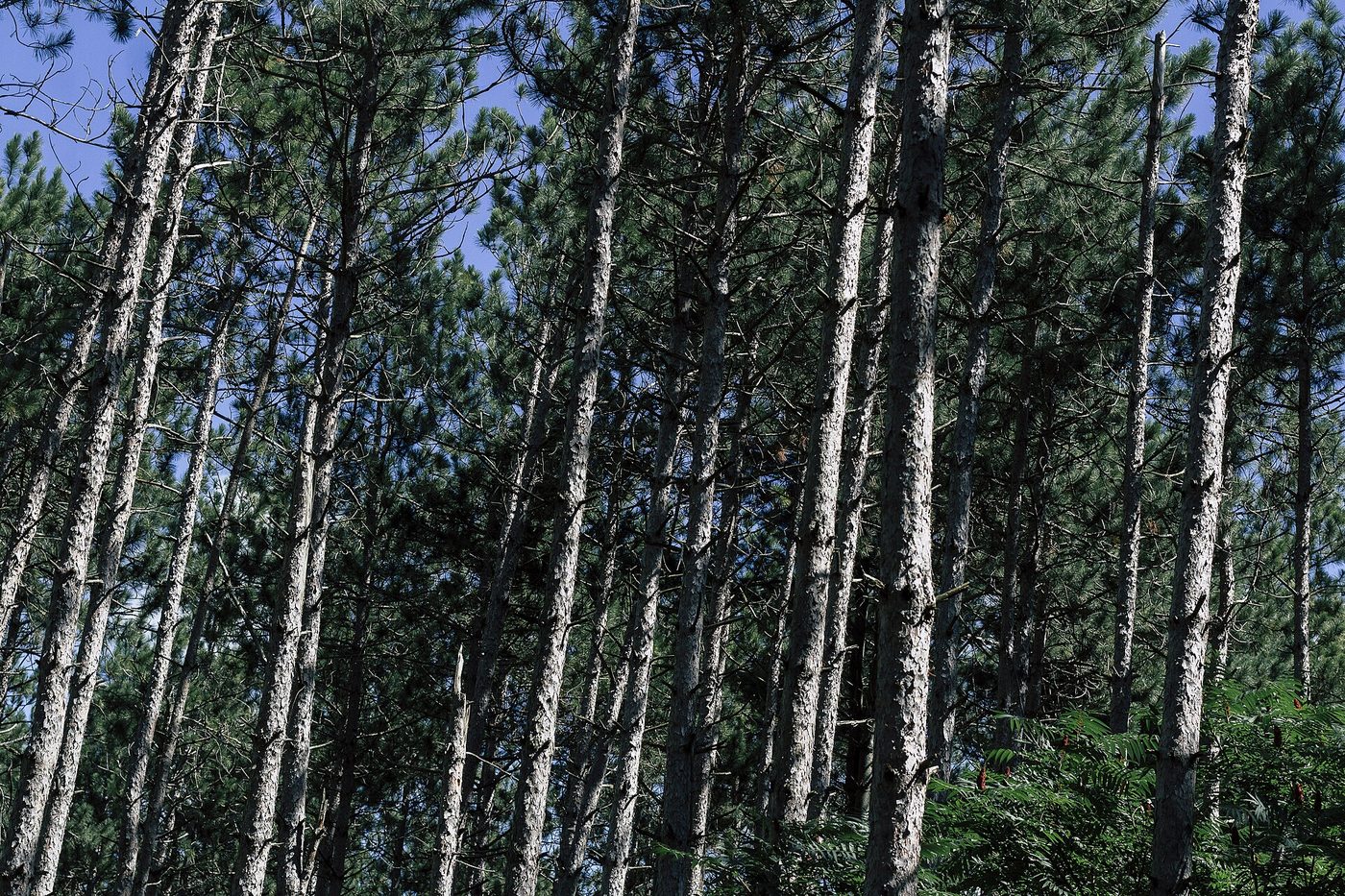
Red pine, also called Norway pine, grows in New England, New York, Pennsylvania, and the Great Lakes region. Its wood resembles a lighter-weight southern pine and goes mainly into building construction.
Appearance & grain
The heartwood is pale red to reddish brown, and the sapwood is nearly white with a yellowish tinge, about 5 to 10 cm wide. The wood is generally straight grained and somewhat resinous, with a less uniform texture than eastern white pine.
Workability
Red pine is moderately heavy, moderately strong and stiff, and moderately soft, with moderately high shock resistance. It has moderately high shrinkage but is not difficult to dry and is dimensionally stable once dried.
Common uses
- Building construction
- Treated decking
- Siding
- Flooring
- Sashes and doors
- General millwork
- Boxes, pallets, and crates
- Cabin logs
- Piles, poles, and posts
- Pulpwood
Conservation: IUCN Red List: Least Concern (checked 2026-10-24).
Work with Red pine
Similar woods
Photo: Jason Zhang · CC BY-SA 3.0 (source)
Property data: USDA Forest Products Laboratory, Wood Handbook — Wood as an Engineering Material, FPL-GTR-282 (2021).