Loblolly pine
Pinus taeda L. · Softwood · North America
Properties
| Janka hardness | 690 lbf (3,069 N) |
|---|---|
| Average dried weight (est.) | 32 lb/ft³ (510 kg/m³) |
| Specific gravity | 0.51 |
| Modulus of rupture | 12,800 psi (88.3 MPa) |
| Modulus of elasticity | 1.79 million psi (12.34 GPa) |
| Crushing strength | 7,130 psi (49.2 MPa) |
| Shrinkage — radial | 4.8% |
| Shrinkage — tangential | 7.4% |
| Shrinkage — volumetric | 12.3% |
| Shrinkage T/R ratio | 1.5 |
Values at 12% moisture content, clear-wood averages. Source: USDA Forest Products Laboratory, Wood Handbook FPL-GTR-282 (2021), Table 5-3 p. 5-12; shrinkage Table 4-3 p. 4-8.
Loblolly pine is one of the four major southern pines that are graded together and marketed as Southern Pine. Its denser, higher-strength lumber goes into structural members — trusses, beams, posts, joists, and piles — while lower-density stock is used for interior woodwork, sheathing, subflooring, and boxes, pallets, and crates.
Appearance & grain
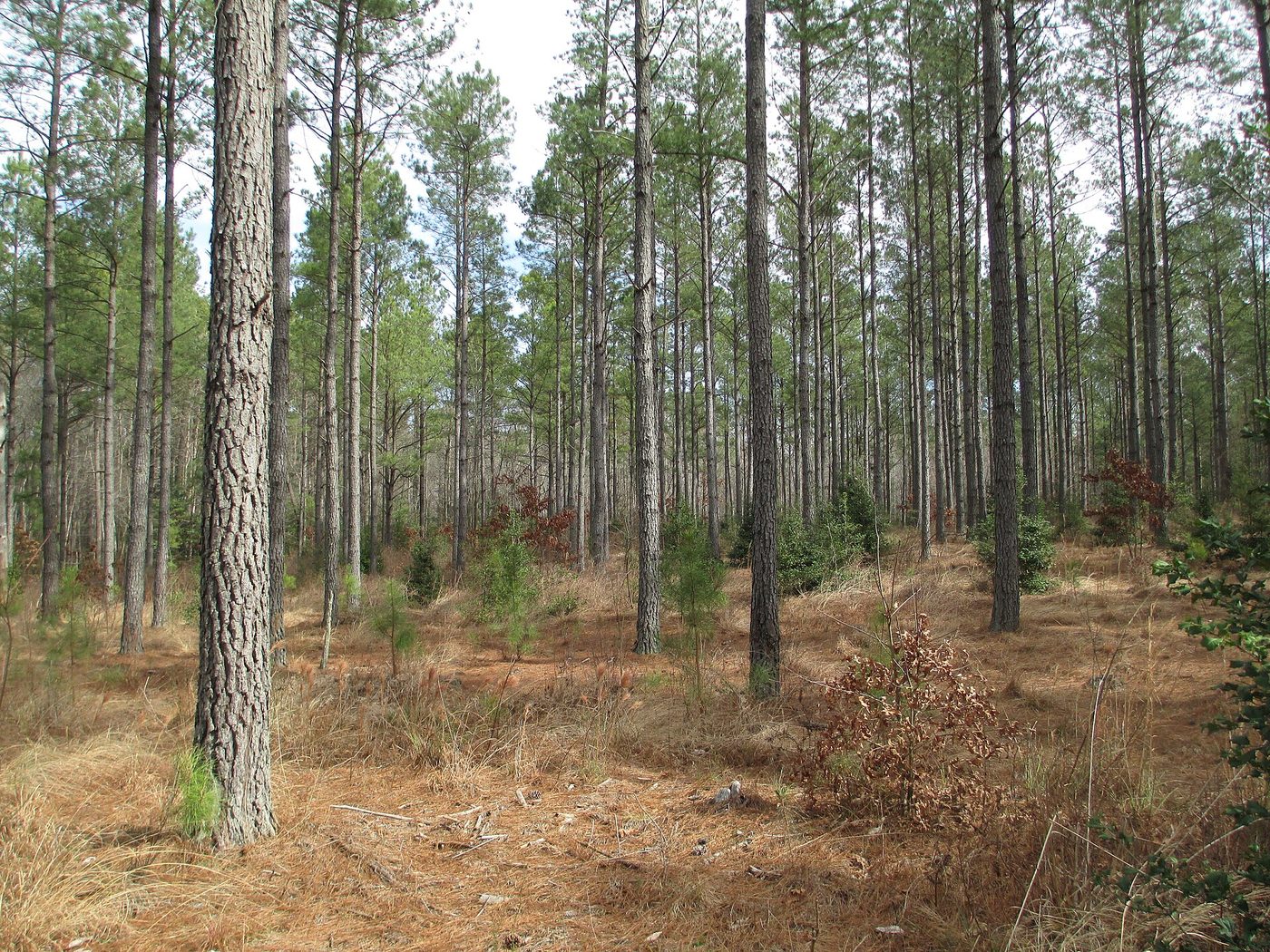
Like the other southern pines, loblolly has yellowish-white sapwood and reddish-brown heartwood. The sapwood is usually wide in second-growth stands, heartwood begins to form at about 20 years, and in old, slow-growth trees the sapwood may be only 2 to 5 cm wide.
Workability
Shortleaf and loblolly are usually somewhat lighter in weight than longleaf pine, the heaviest of the group. All of the southern pines have moderately high shrinkage but are dimensionally stable when properly dried, and a density rule based on latewood percentage and growth rates is specified for structural timbers.
Common uses
- Stringers, beams, posts, and joists
- Roof trusses
- Piles
- Interior woodwork
- Sheathing and subflooring
- Boxes, pallets, and crates
- Tight and slack cooperage
- Railroad crossties
- Poles
- Mine timbers
- Exterior decking (preservative-treated)
- Structural plywood
Conservation: IUCN Red List: Least Concern (checked 2026-10-24).
Work with Loblolly pine
Similar woods
Related reading: Read our loblolly pine lumber guide
Photo: Antepenultimate · CC BY-SA 4.0 (source)
Property data: USDA Forest Products Laboratory, Wood Handbook — Wood as an Engineering Material, FPL-GTR-282 (2021).