Noble Fir
Abies procera Rehd. · Softwood · North America
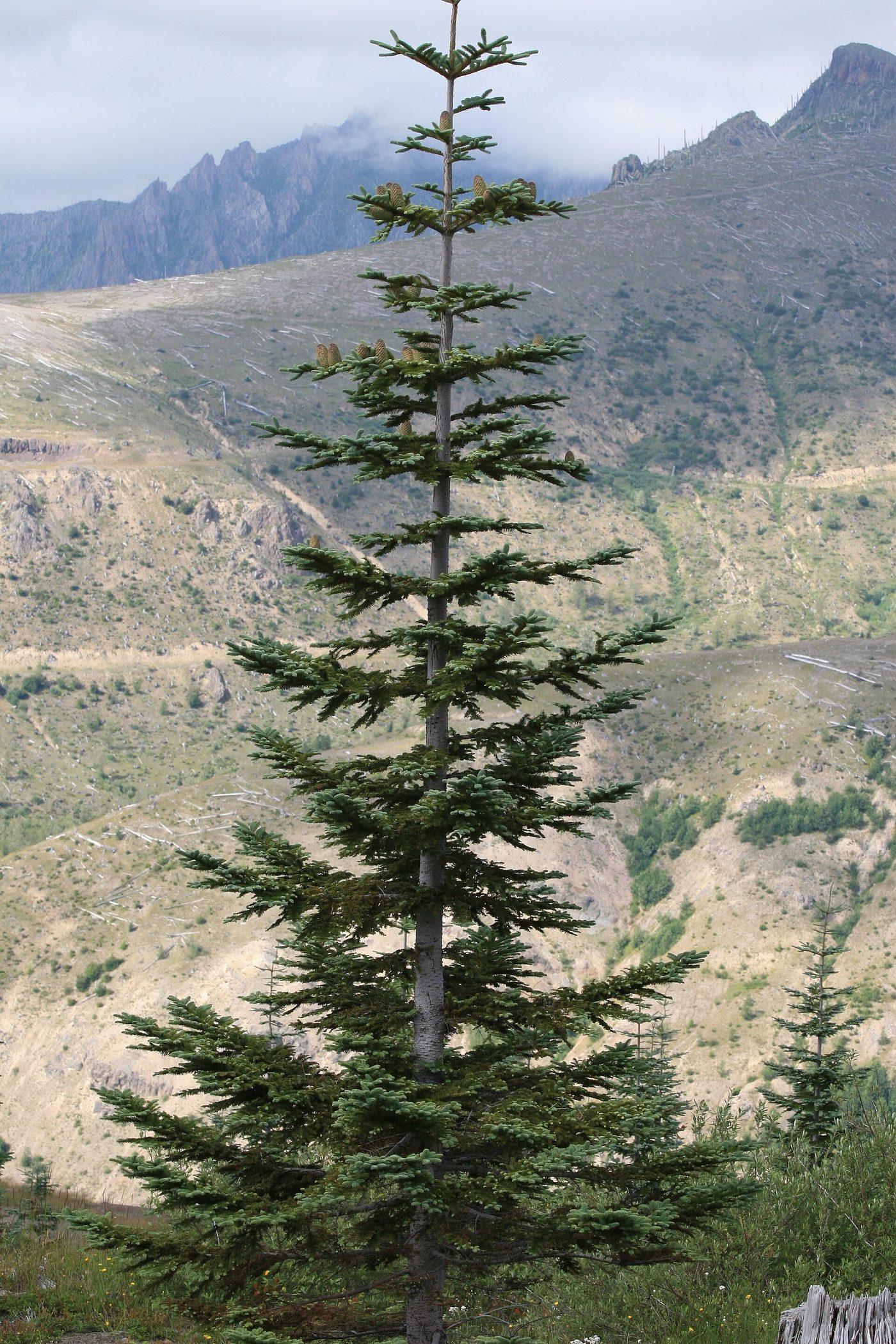
Properties
| Janka hardness | 410 lbf (1,824 N) |
|---|---|
| Average dried weight (est.) | 24 lb/ft³ (390 kg/m³) |
| Specific gravity | 0.39 |
| Modulus of rupture | 10,700 psi (73.8 MPa) |
| Modulus of elasticity | 1.72 million psi (11.86 GPa) |
| Crushing strength | 6,100 psi (42.1 MPa) |
| Shrinkage — radial | 4.3% |
| Shrinkage — tangential | 8.3% |
| Shrinkage — volumetric | 12.4% |
| Shrinkage T/R ratio | 1.9 |
Values at 12% moisture content, clear-wood averages. Source: USDA Forest Products Laboratory, Wood Handbook FPL-GTR-282 (2021), Table 5–3b p. 5–12; shrinkage Table 4–3 p. 4–8.
Noble fir is one of the western true firs marketed together as white fir, and its high-grade lumber is used mainly for interior woodwork, molding, and siding. Some of the highest quality material is suitable for aircraft construction, with special uses such as venetian blinds and ladder rails.
Appearance & grain
Like the other western true firs, noble fir's wood is creamy white to pale brown, and the heartwood and sapwood are generally indistinguishable. The western true fir species cannot be told apart from one another by the wood alone.
Workability
The wood of the western true firs is light in weight, and its shrinkage is low to moderately high. The western true firs, noble fir among them, have somewhat higher strength properties than the eastern balsam fir.
Common uses
- Interior woodwork
- Molding
- Siding
- Sash and door stock
- Aircraft construction
- Venetian blinds
- Ladder rails
- Building construction
- Boxes and crates
- Planing-mill products
- General millwork
- Framing, subflooring, and sheathing
Conservation: IUCN Red List: Least Concern (checked 2026-10-24).
Work with Noble Fir
Similar woods
Photo: mamamusings on Flickr · CC BY-SA 2.0 (source)
Property data: USDA Forest Products Laboratory, Wood Handbook — Wood as an Engineering Material, FPL-GTR-282 (2021).