Alaska Yellow Cedar
Chamaecyparis nootkatensis (D. Don) Spach · Softwood · North America
Properties
| Janka hardness | 580 lbf (2,580 N) |
|---|---|
| Average dried weight (est.) | 27 lb/ft³ (440 kg/m³) |
| Specific gravity | 0.44 |
| Modulus of rupture | 11,100 psi (76.5 MPa) |
| Modulus of elasticity | 1.42 million psi (9.79 GPa) |
| Crushing strength | 6,310 psi (43.5 MPa) |
| Shrinkage — radial | 2.8% |
| Shrinkage — tangential | 6.0% |
| Shrinkage — volumetric | 9.2% |
| Shrinkage T/R ratio | 2.1 |
Values at 12% moisture content, clear-wood averages. Source: USDA Forest Products Laboratory, Wood Handbook FPL-GTR-282 (2021), Table 5–3b p. 5–12; shrinkage Table 4–3 p. 4–8.
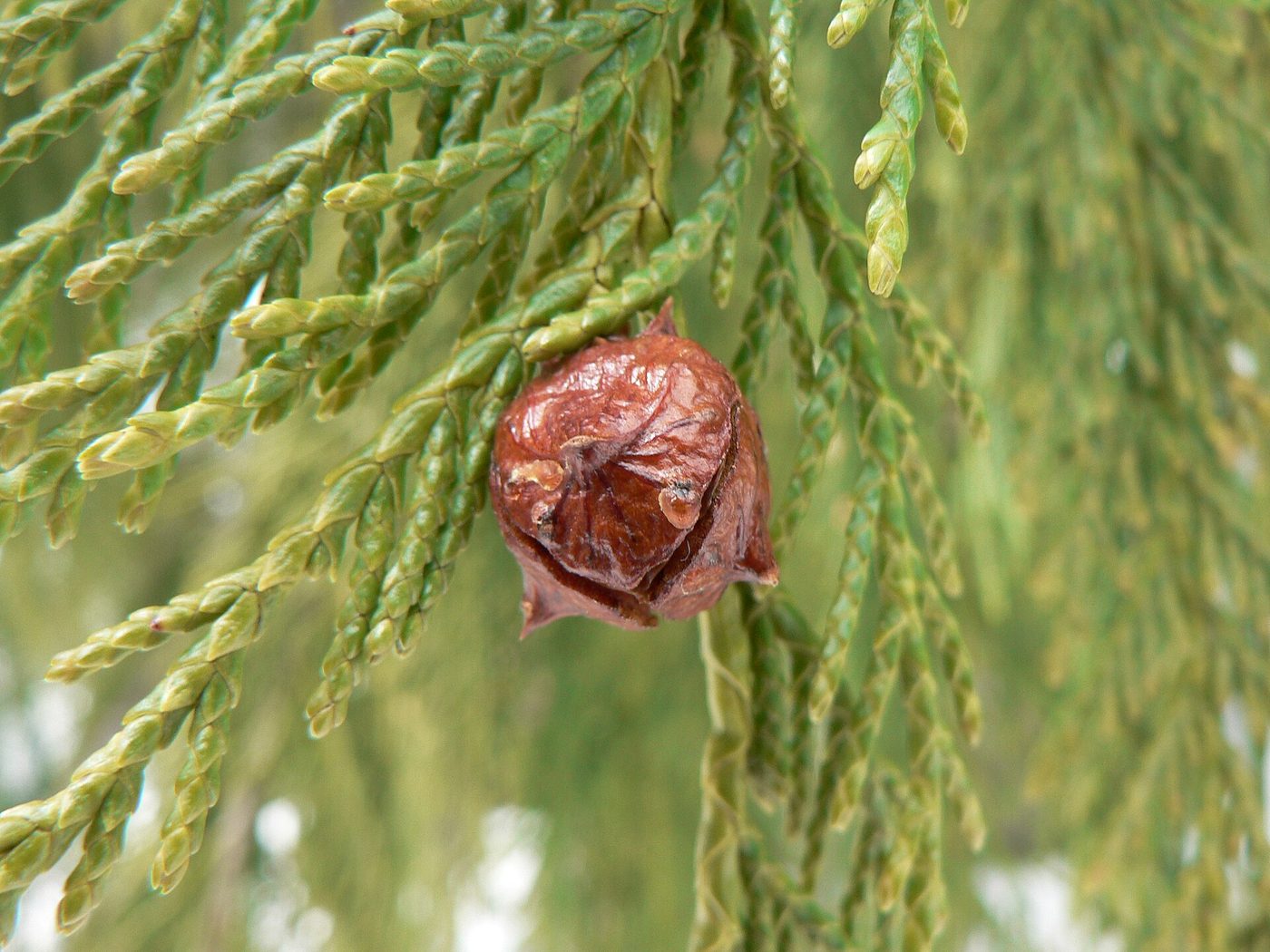
Alaska yellow-cedar is a fine-textured, bright yellow softwood (specific gravity 0.44, Janka hardness 580 lbf) whose heartwood is very resistant to decay. It is used for interior woodwork, furniture, small boats, and cabinetwork.
Appearance & grain
The heartwood is a bright, clear yellow. The sapwood is narrow and white to yellowish, hardly distinguishable from the heartwood. The texture is fine, the grain generally straight, and the wood carries a mild, distinctive odor.
Durability
The heartwood is very resistant to decay.
Workability
The Handbook notes that yellow-cedar shrinks little in drying and is stable after drying. It is moderately heavy, moderately strong and stiff, and moderately hard, with moderately high shock resistance.
Common uses
- Interior woodwork
- Furniture
- Small boats
- Cabinetwork
- Novelties
Conservation: IUCN Red List: Least Concern (checked 2026-10-24).
Work with Alaska Yellow Cedar
Similar woods
Photo: Walter Siegmund (talk) · CC BY-SA 3.0 (source)
Property data: USDA Forest Products Laboratory, Wood Handbook — Wood as an Engineering Material, FPL-GTR-282 (2021).