Shellbark Hickory
Carya laciniosa · Hardwood · North America
Properties
| Janka hardness | 1,810 lbf (8,051 N) |
|---|---|
| Average dried weight (est.) | 43 lb/ft³ (690 kg/m³) |
| Specific gravity | 0.69 |
| Modulus of rupture | 18,100 psi (124.8 MPa) |
| Modulus of elasticity | 1.89 million psi (13.03 GPa) |
| Crushing strength | 8,000 psi (55.2 MPa) |
| Shrinkage — radial | 7.6% |
| Shrinkage — tangential | 12.6% |
| Shrinkage — volumetric | 19.2% |
| Shrinkage T/R ratio | 1.7 |
Values at 12% moisture content, clear-wood averages. Source: USDA Forest Products Laboratory, Wood Handbook FPL-GTR-282 (2021), Table 5–3b p. 5–10; shrinkage Table 4–3 p. 4–8.
Shellbark hickory is one of the commercially most important true hickories of the eastern United States. Its exceptionally tough, heavy, strong wood is prized for tool handles and other high-shock uses, with lower grades going to pallets.
Appearance & grain
The true hickories have white sapwood, usually quite wide except in old, slow-grown trees, and reddish heartwood.
Workability
Hickory shrinks considerably in drying. For some purposes the wood's weight and the number of growth rings per unit of width are limiting factors in how it can be used.
Common uses
- Tool handles
- Ladder rungs
- Athletic goods
- Agricultural implements
- Dowels
- Gymnasium equipment
- Poles
- Furniture
- Pallets
- Meat smoking (chips and sawdust)
Conservation: IUCN Red List: Least Concern (checked 2026-10-24).
Work with Shellbark Hickory
Similar woods
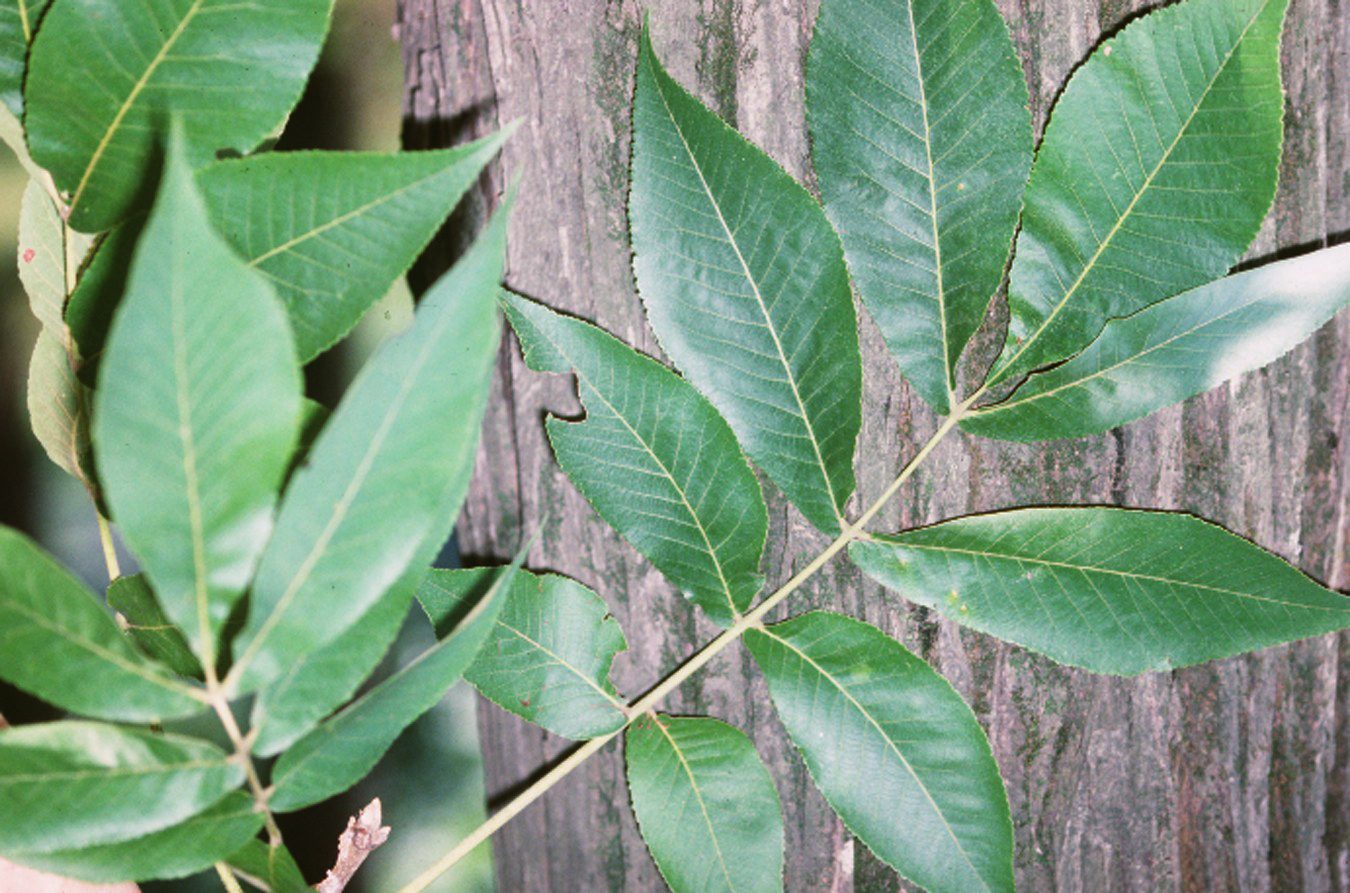
Photo: Robert H. Mohlenbrock. USDA SCS. Midwest wetland flora: Field office illustrated guide to plant species. · Public domain (source)
Property data: USDA Forest Products Laboratory, Wood Handbook — Wood as an Engineering Material, FPL-GTR-282 (2021).