Tamarack
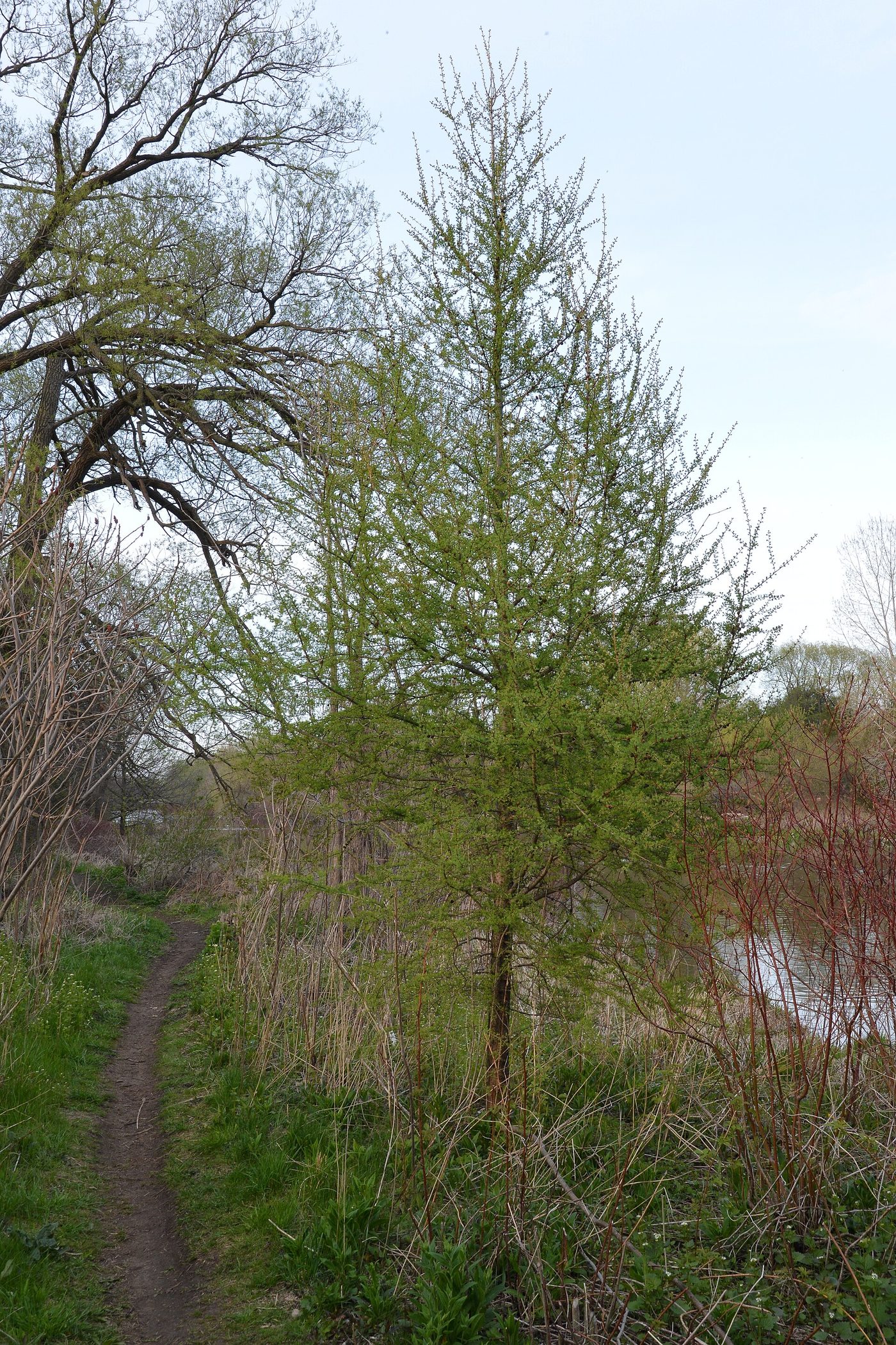
Larix laricina (Du Roi) K. Koch · Softwood · North America
Properties
| Janka hardness | 590 lbf (2,624 N) |
|---|---|
| Average dried weight (est.) | 33 lb/ft³ (530 kg/m³) |
| Specific gravity | 0.53 |
| Modulus of rupture | 11,600 psi (80.0 MPa) |
| Modulus of elasticity | 1.64 million psi (11.31 GPa) |
| Crushing strength | 7,160 psi (49.4 MPa) |
| Shrinkage — radial | 3.7% |
| Shrinkage — tangential | 7.4% |
| Shrinkage — volumetric | 13.6% |
| Shrinkage T/R ratio | 2.0 |
Values at 12% moisture content, clear-wood averages. Source: USDA Forest Products Laboratory, Wood Handbook FPL-GTR-282 (2021), Table 5–3b p. 5–13; shrinkage Table 4–3 p. 4–8.
Tamarack is a coarse-textured northern softwood (specific gravity 0.53, Janka hardness 590 lbf) that sits in the middle of the pack for weight and most mechanical properties. It is cut principally for pulpwood and lumber.
Appearance & grain
The heartwood is yellowish brown to russet brown. The sapwood is whitish and generally less than 3 cm wide. The texture is coarse, the earlywood passes abruptly into the latewood, and the wood has no odor or taste.
Workability
The Handbook places tamarack at an intermediate level in weight and in most mechanical properties. Its lumber is used for framing material, tank construction, boxes, pallets, and crates.
Common uses
- Pulpwood
- Lumber
- Railroad crossties
- Mine timbers
- Fence posts
- Poles
- Fuel
Conservation: IUCN Red List: Least Concern (checked 2026-10-24).
Work with Tamarack
Similar woods
Photo: Ryan Hodnett · CC BY-SA 4.0 (source)
Property data: USDA Forest Products Laboratory, Wood Handbook — Wood as an Engineering Material, FPL-GTR-282 (2021).