Western Hemlock
Tsuga heterophylla (Raf.) Sarg. · Softwood · North America
Properties
| Janka hardness | 540 lbf (2,402 N) |
|---|---|
| Average dried weight (est.) | 28 lb/ft³ (450 kg/m³) |
| Specific gravity | 0.45 |
| Modulus of rupture | 11,300 psi (77.9 MPa) |
| Modulus of elasticity | 1.63 million psi (11.24 GPa) |
| Crushing strength | 7,200 psi (49.6 MPa) |
| Shrinkage — radial | 4.2% |
| Shrinkage — tangential | 7.8% |
| Shrinkage — volumetric | 12.4% |
| Shrinkage T/R ratio | 1.9 |
Values at 12% moisture content, clear-wood averages. Source: USDA Forest Products Laboratory, Wood Handbook FPL-GTR-282 (2021), Table 5–3b p. 5–12; shrinkage Table 4–3 p. 4–8.
Western hemlock is a moderately light softwood (specific gravity 0.45, Janka hardness 540 lbf) of moderate strength, hardness, and stiffness. It is a major pulpwood, lumber, and plywood species, its lumber going mainly to building material.
Appearance & grain
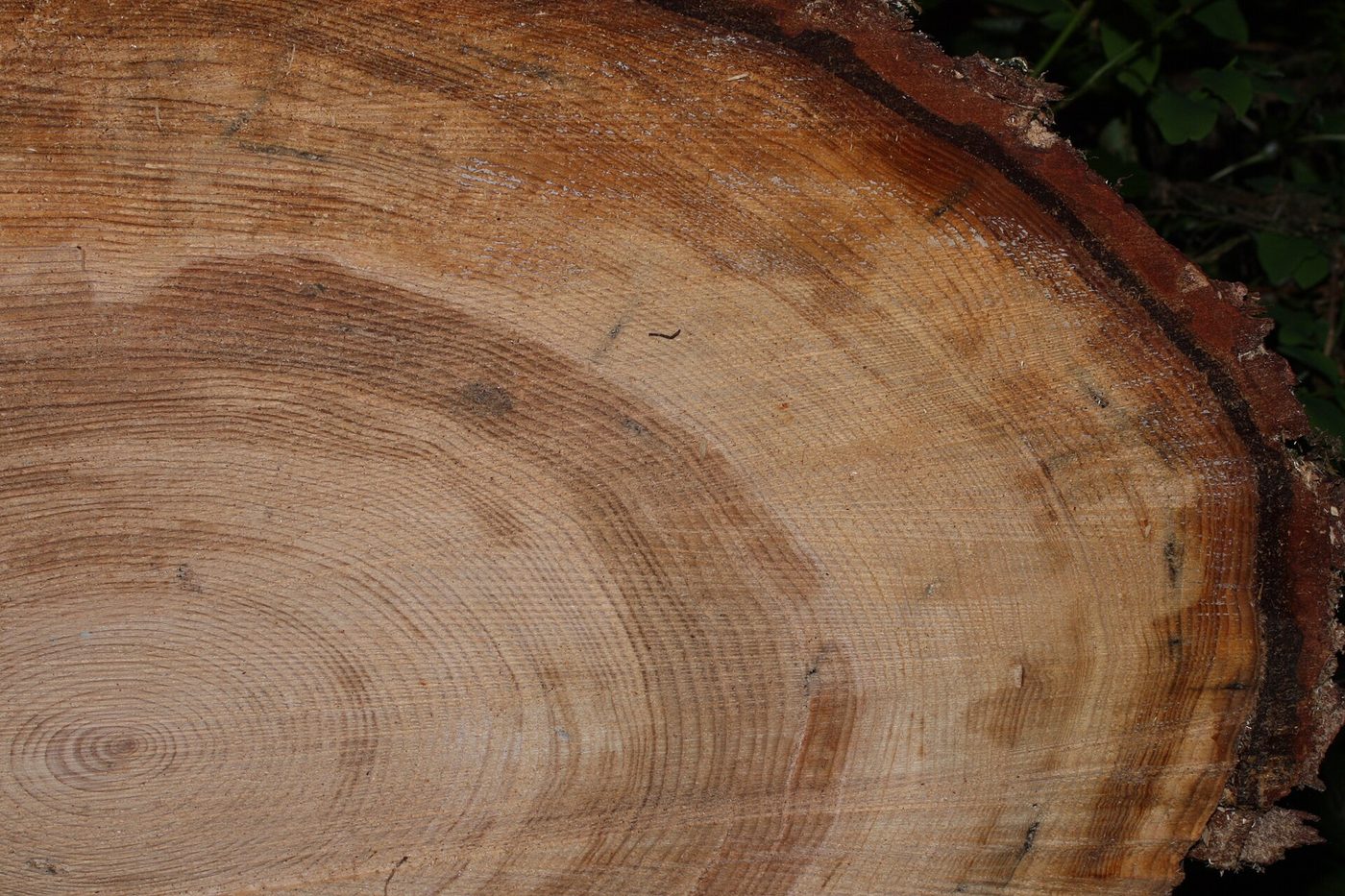
Heartwood and sapwood are both almost white with a purplish tinge, and the sapwood is generally no more than about 2.5 cm wide. The wood often contains small, sound, tight black knots, and dark streaks left by hemlock bark maggots do not reduce its strength.
Workability
Shrinkage is moderately high, about the same as Douglas-fir's. Green hemlock lumber holds considerably more water than Douglas-fir and needs a longer kiln-drying schedule.
Common uses
- Pulpwood
- Lumber
- Plywood
- Building material
- Boxes
- Pallets
- Crates
- Flooring
- Furniture
- Ladders
Conservation: IUCN Red List: Least Concern (checked 2026-10-24).
Work with Western Hemlock
Similar woods
Photo: Walter Siegmund (talk) · CC BY-SA 3.0 (source)
Property data: USDA Forest Products Laboratory, Wood Handbook — Wood as an Engineering Material, FPL-GTR-282 (2021).