White limba
Terminalia superba · Hardwood · West Africa
Properties
| Janka hardness | 490 lbf (2,180 N) |
|---|---|
| Average dried weight (est.) | 24 lb/ft³ (380 kg/m³) |
| Specific gravity | 0.38 |
| Modulus of rupture | 8,800 psi (60.7 MPa) |
| Modulus of elasticity | 1.01 million psi (6.96 GPa) |
| Crushing strength | 4,730 psi (32.6 MPa) |
| Shrinkage — radial | 4.5% |
| Shrinkage — tangential | 6.2% |
| Shrinkage — volumetric | 10.8% |
| Shrinkage T/R ratio | 1.4 |
Values at 12% moisture content, clear-wood averages. Source: USDA Forest Products Laboratory, Wood Handbook FPL-GTR-282 (2021), Table 5-5b p. 5-23; shrinkage Table 4-4 p. 4-9.
White limba (Terminalia superba), also called afara or korina, is a light West African hardwood (specific gravity 0.38, Janka hardness 490 lbf) widely distributed from Sierra Leone to Angola and favored as a plantation species. It is listed as Least Concern on the IUCN Red List (assessed 2024) and is not listed in the CITES Appendices.
Appearance & grain
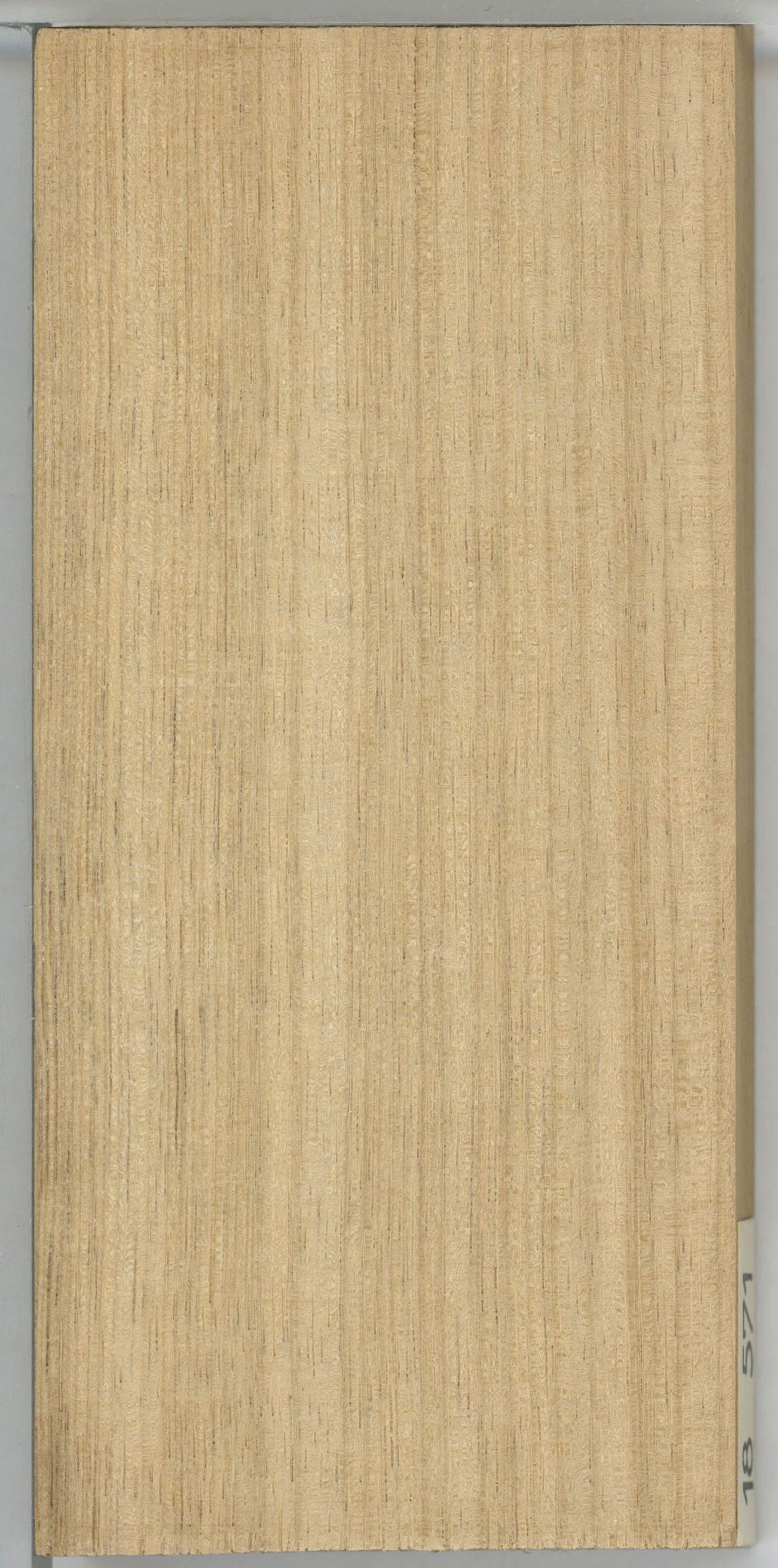
The heartwood varies from gray-white to creamy or yellow brown and may contain dark streaks that are nearly black, producing an attractive figure valued for decorative veneer. The wood is generally straight grained, of uniform but coarse texture, and its light color is an asset for blond furniture.
Durability
The Handbook states plainly that limba is not resistant to decay, insects, or termites.
Workability
The Handbook says limba is easy to dry, with shrinkage reported to be rather low, and that it is easy to work with all types of tools and is made into veneer without difficulty.
Common uses
- Plywood
- Furniture
- Interior joinery
- Sliced decorative veneer
Conservation: IUCN Red List: Least Concern (checked 2026-10-25).
Work with White limba
Similar woods
Photo: Centre de coopération internationale en recherche agronomique pour le développement (France). Programme Bois. Producteur d'un fonds d'archives · Public domain (source)
Property data: USDA Forest Products Laboratory, Wood Handbook — Wood as an Engineering Material, FPL-GTR-282 (2021).