American Basswood
Tilia americana · Hardwood · North America
Properties
| Janka hardness | 410 lbf (1,824 N) |
|---|---|
| Average dried weight (est.) | 23 lb/ft³ (370 kg/m³) |
| Specific gravity | 0.37 |
| Modulus of rupture | 8,700 psi (60.0 MPa) |
| Modulus of elasticity | 1.46 million psi (10.07 GPa) |
| Crushing strength | 4,730 psi (32.6 MPa) |
| Shrinkage — radial | 6.6% |
| Shrinkage — tangential | 9.3% |
| Shrinkage — volumetric | 15.8% |
| Shrinkage T/R ratio | 1.4 |
Values at 12% moisture content, clear-wood averages. Source: USDA Forest Products Laboratory, Wood Handbook FPL-GTR-282 (2021), Table 5–3b p. 5–9; shrinkage Table 4–3 p. 4–8.
American basswood is one of the lightest, softest commercial hardwoods in North America (specific gravity 0.37, Janka hardness 410 lbf), prized less for strength than for how cleanly and easily it works. It is a traditional favorite of wood carvers and a staple for blinds, boxes, and woodenware.
Appearance & grain
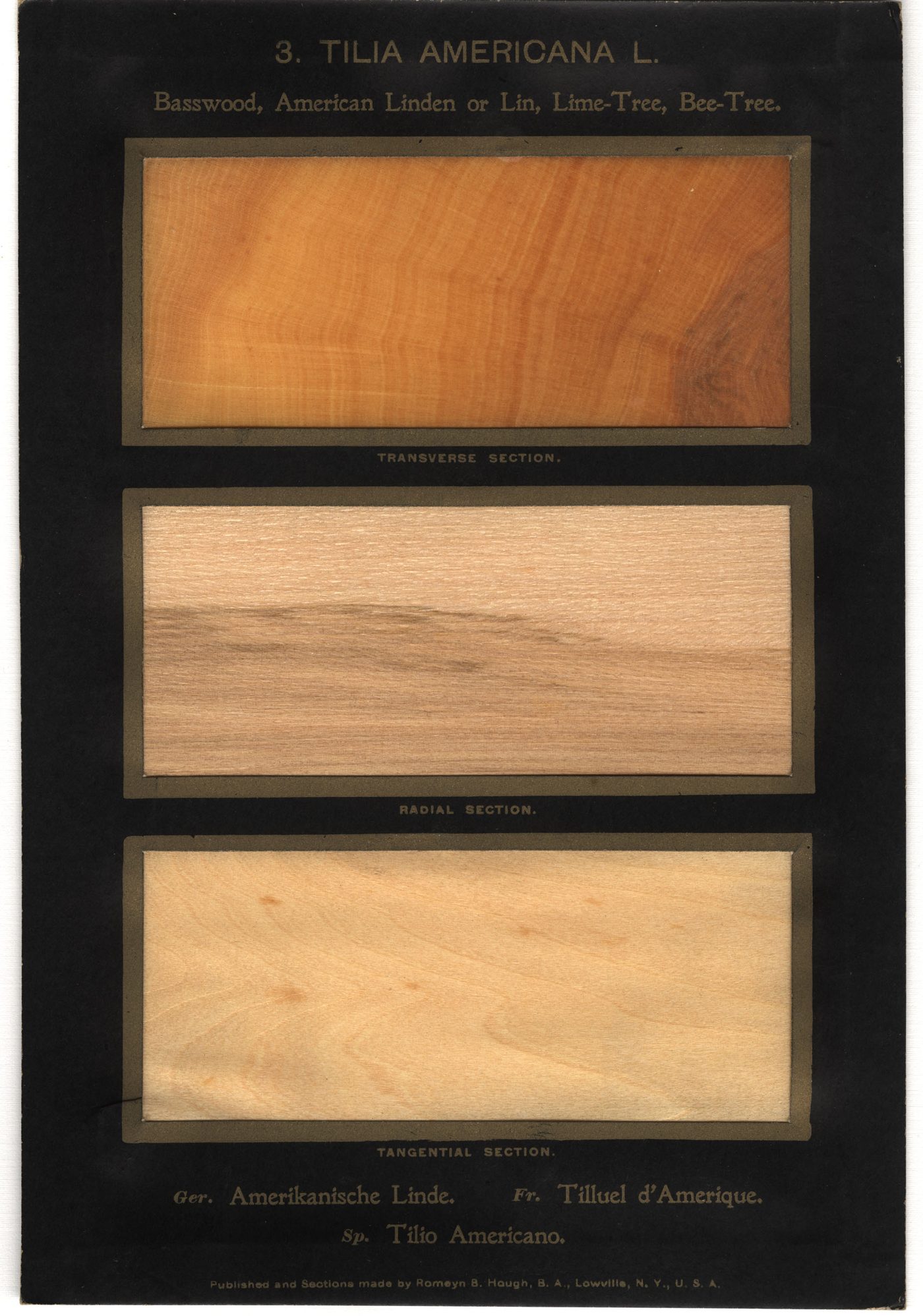
The heartwood is pale yellowish brown, sometimes showing darker streaks. The sapwood is wide, creamy white to pale brown, and merges into the heartwood so gradually that the two are often hard to tell apart. The wood has a fine, even texture with generally straight grain, and the dried wood is odorless and tasteless.
Workability
The Handbook singles basswood out as easy to work, one reason it has long been a favorite wood for carvers. Its shrinkage is rated high, yet the wood seldom warps in service.
Common uses
- Venetian blinds
- Window sashes and door frames
- Molding
- Apiary supplies
- Woodenware
- Boxes
- Veneer
- Cooperage
- Excelsior
- Pulpwood
- Hand carving
Conservation: IUCN Red List: Least Concern (checked 2026-10-24).
Work with American Basswood
Similar woods
Photo: Romeyn Beck Hough · Public domain (source)
Property data: USDA Forest Products Laboratory, Wood Handbook — Wood as an Engineering Material, FPL-GTR-282 (2021).